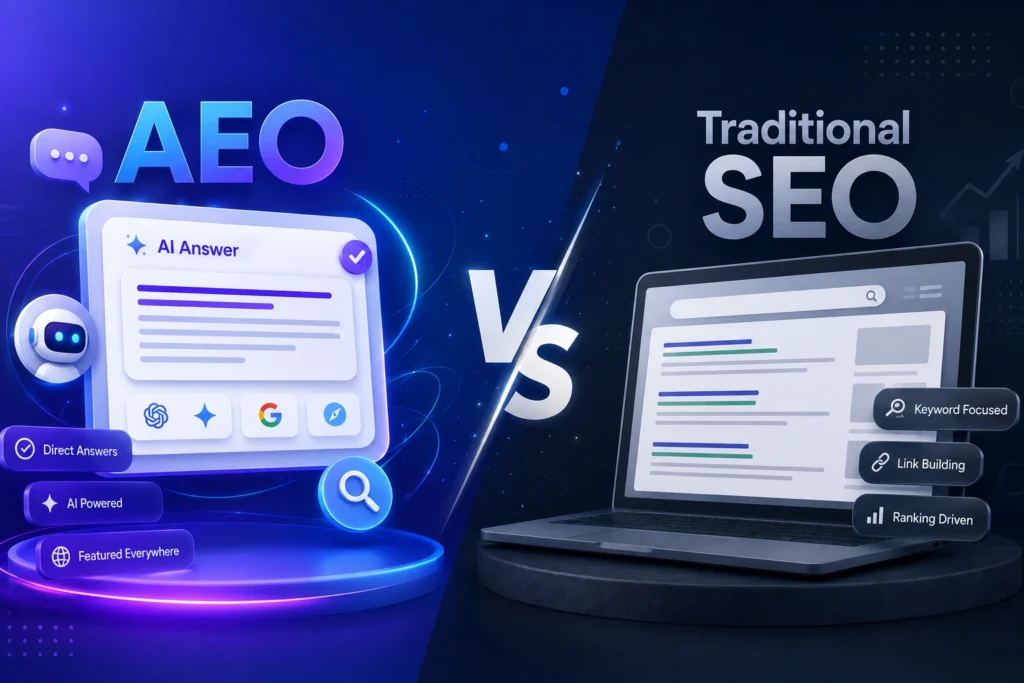
Search is changing. People still use Google and other search engines to find webpages, but they are increasingly asking conversational questions and expecting direct answers from AI-powered search experiences.
This shift has created greater interest in Answer Engine Optimization (AEO). Traditional SEO remains essential for organic visibility, while AEO focuses on making information easier for answer engines and AI systems to understand, retrieve, and potentially cite.
The two approaches are closely connected, but they have different primary goals, content approaches, and success metrics. Understanding the difference helps businesses build a search strategy that works across traditional search results and AI-generated answers.
What Is SEO?
Search Engine Optimization (SEO) is the process of improving a website and its content to increase its visibility in search engines.
Traditional SEO covers several areas, including:
- Keyword research
- Search intent
- Technical optimization
- On-page optimization
- Content development
- Internal linking
- Backlink acquisition
- Website performance
- Local search optimization
- User experience
The objective is to help search engines discover, understand, evaluate, and rank relevant webpages.
For example, a company targeting “digital marketing services” may create a dedicated service page, optimize its technical structure, research relevant search terms, publish supporting content, improve internal links, and develop authority around the subject.
SEO is therefore much broader than keyword placement.
What Is AEO?
What is AEO? AEO, or Answer Engine Optimization, is an approach focused on improving the likelihood that a brand’s information will be discovered, understood, and used in direct answers generated by AI-powered search systems.
Instead of asking only:
“How can I rank this page?”
AEO also asks:
“How can I make this information clear and useful enough for an answer engine to retrieve and use?”
AI-powered systems such as ChatGPT, Google AI features, and Perplexity can retrieve information, evaluate sources, and generate responses instead of simply displaying a list of webpages. Current industry guidance describes AEO primarily around visibility through AI-generated answers, citations, and mentions.
SEO vs AEO: The Core Difference
The simplest distinction is:
SEO → Optimize for search visibility and rankings.
AEO → Optimize for visibility in direct and AI-generated answers.
However, the two approaches overlap significantly.
Strong technical SEO can help content remain discoverable. High-quality content can support both organic rankings and AI visibility. Authority and trustworthy information can also benefit both environments.
Research and industry guidance indicate that AI systems do not always select the exact pages that rank highest in traditional search. They may retrieve deeper pages, supporting articles, documentation, or other relevant sources from authoritative websites.
Therefore, ranking well is valuable, but it does not automatically guarantee inclusion in an AI-generated response.
Why SEO Still Matters for AEO
AEO does not replace traditional SEO.
AI systems need to discover and retrieve information before they can potentially use it in an answer. A technically inaccessible website, poor information architecture, or weak content organization can make this process more difficult.
Important SEO foundations include:
- Crawlability
- Indexability
- Website structure
- Internal linking
- Mobile usability
- Page performance
- Relevant metadata
- Content quality
- Clear information architecture
AEO should therefore be viewed as an extension of a broader search strategy rather than a replacement for SEO. Semrush similarly describes SEO as a foundation that can support visibility in AI-generated experiences.
How AEO Changes Content Strategy
Traditional SEO content often begins with keyword research.
An AEO-focused strategy can begin with the question behind the keyword.
For example, the topic “local SEO services” can lead to questions such as:
- What are local SEO services?
- How does local SEO work?
- How much do local SEO services cost?
- What does a local SEO company do?
- How long does local SEO take?
These questions represent different information needs.
Instead of creating several shallow pages that repeat similar terminology, a strong content strategy can organize related questions into useful, logically connected resources.
Direct Answers Are Important for AEO
One of the simplest ways to make content easier to understand is to answer important questions directly.
For example:
What Is Search Intent?
Search intent is the reason or purpose behind a user’s search query. It describes what the user is trying to learn, compare, purchase, find, or accomplish.
The direct answer can then be followed by examples, explanations, statistics, or practical steps.
This structure helps readers find information quickly and creates clear answer units that automated systems can interpret more easily. Semrush recommends using question-based headings followed immediately by concise answers before adding supporting detail.
How Structured Content Helps AI Search
AI systems process large amounts of information. Clear structure can help establish relationships between questions, answers, topics, and supporting information.
Useful formats include:
- Definition sections
- Comparison tables
- Step-by-step instructions
- FAQs
- Bullet lists
- Numbered lists
- Short explanatory paragraphs
- Descriptive headings
- Relevant examples
For example, a comparison table can communicate differences between SEO and AEO more efficiently than several paragraphs.
Structured data can also help explicitly describe content types such as FAQs, products, or reviews when applicable. However, adding schema does not guarantee AI citations or visibility.
AEO and Conversational Search
Search queries are becoming increasingly conversational.
Instead of searching:
“SEO benefits business”
a user might ask:
“How can SEO help my small business get more customers?”
The second query provides more context and clearly expresses an information need.
Content should therefore address natural questions rather than relying exclusively on short keyword phrases.
Useful question formats include:
- What is…?
- Why does…?
- How does…?
- How can I…?
- What is the difference between…?
- Which is better…?
- How much does…?
- When should…?
This approach can make content more useful for users while providing clear question-and-answer relationships for AI systems.
AEO vs SEO vs GEO
AEO is often discussed alongside Generative Engine Optimization (GEO) and AI SEO. Although terminology varies across the industry, the concepts generally overlap around improving visibility in evolving AI-powered search experiences.
| SEO | AEO | GEO | |
| Primary goal | Search visibility | Answer visibility | Generative AI visibility |
| Main environment | Search engines | Answer engines and AI search | Generative AI systems |
| Main outcome | Rankings and organic traffic | Answers, mentions, citations | Mentions, citations, and AI visibility |
| Content focus | Relevance, depth, technical quality | Direct answers and clear information | Information that AI systems can retrieve and use |
| Key considerations | Keywords, links, technical SEO | Questions, structure, entities, answers | Authority, context, entities, originality |
These approaches should not be treated as completely separate disciplines. A well-structured page can support traditional search, answer engines, and generative AI experiences simultaneously.
How to Optimize Content for Both SEO and AEO
1. Start With Search Intent
Identify what the user actually wants to accomplish before creating the page.
2. Identify Important Questions
Research the questions users ask around the main topic and answer them naturally.
3. Give Direct Answers
Provide a concise answer near the beginning of each important section.
4. Build Topical Depth
Cover important supporting concepts instead of creating shallow content around every keyword variation.
5. Use Clear Headings
Make headings descriptive so readers and systems can immediately understand what each section covers.
6. Add Useful Examples
Examples provide context and help explain complicated concepts.
7. Use Structured Information
Use tables, lists, definitions, and FAQs where they genuinely improve understanding.
8. Support Important Claims
Use trustworthy sources, evidence, original research, or relevant expertise when making important claims.
9. Strengthen Entity Relationships
Clearly identify relevant businesses, people, products, services, locations, and concepts. Consistent entity terminology helps search and AI systems understand relationships between topics.
10. Keep Information Current
Review important pages periodically and update outdated facts, examples, statistics, screenshots, and recommendations.
Freshness is particularly important for subjects where information changes quickly.
Original Expertise: A Key Advantage for AI Search
One of the strongest opportunities for businesses is adding information that cannot easily be reproduced from generic sources.
This can include:
- First-hand experience
- Original research
- Internal data
- Expert opinions
- Case studies
- Real-world examples
- Tested processes
- Original frameworks
For example, a business could document how it improved a client’s organic visibility, explain what was tested, describe the outcome, and share the lessons learned.
This creates information with greater originality and practical value than a generic definition.
Industry research and guidance increasingly associate AI visibility with content demonstrating expertise, experience, authority, and trust.
Basar Mir’s AEO Framework
At Basar Mir, a practical way to approach AEO is to connect the user’s question with the information needed to answer it clearly:
Understand → Answer → Explain → Support → Structure → Strengthen → Monitor
Understand
Identify the searcher’s actual intent.
Answer
Give a direct response to the main question.
Explain
Provide enough context to make the answer useful.
Support
Back important claims with evidence, experience, or trustworthy sources.
Structure
Use logical headings, lists, tables, and other formats that improve comprehension.
Strengthen
Build topical authority, entity relationships, and brand credibility.
Monitor
Track traditional search performance alongside AI visibility, citations, and brand mentions.
This framework keeps AEO connected to useful content rather than treating it as a separate keyword tactic.
How to Measure SEO and AEO Performance
Traditional SEO and AEO require different performance measurements.
SEO Metrics
Common SEO metrics include:
- Organic clicks
- Impressions
- Click-through rate
- Average position
- Organic traffic
- Keyword rankings
- Conversions
- Backlinks
AEO Metrics
AEO measurement can include:
- AI citations
- Brand mentions
- Answer inclusion
- AI referral traffic
- AI visibility
- Questions where the brand appears
- Competitor mentions
- Referral conversions
Measurement capabilities vary between AI platforms, so there is no universal AEO metric that works everywhere. However, monitoring both traditional and AI search visibility provides a broader picture of how users discover a brand.
Common AEO Mistakes to Avoid
Keyword Stuffing
Repeating the same phrase unnecessarily does not make content more useful.
Writing Only for AI
Content should serve human readers first. Artificial or overly formulaic writing can reduce clarity and trust.
Ignoring Technical SEO
AEO cannot compensate for serious crawlability, indexability, or accessibility problems.
Creating Too Many Similar Pages
Multiple pages targeting almost identical questions can create content overlap and weaken your site’s topical organization.
Making Unsupported Claims
Unverified claims can reduce credibility and make content less trustworthy.
Relying Only on FAQs
FAQs can support AEO, but effective optimization involves the entire content experience, not just adding questions at the bottom of a page.
Final Takeaway
AEO and traditional SEO have different primary objectives, but they work best together.
SEO helps your website become visible in search results. AEO helps make your information useful for direct and AI-generated answers.
The future of search is not about choosing between the two. It is about building a strong SEO foundation and creating information that is clear, authoritative, structured, useful, and easy to understand across evolving search experiences.
At Basar Mir, the practical approach is to understand the user’s question, provide the clearest answer, support it with useful context and evidence, maintain strong technical foundations, and build authority around the subject.
Frequently Asked Questions
What is the main difference between AEO and SEO?
SEO primarily focuses on improving visibility in traditional search results, while AEO focuses on making information more likely to be included in direct or AI-generated answers.
Is AEO replacing traditional SEO?
No. AEO complements SEO. Technical accessibility, relevant content, authority, and website structure remain important foundations.
Does SEO help with AEO?
Yes. Many SEO fundamentals support AEO because AI systems still need to discover, retrieve, and interpret reliable information.
Does AEO require AI-generated content?
No. AEO does not require content to be created by AI. Human-created content can perform well when it is accurate, useful, well structured, original, and relevant.
How can I make my content AEO-friendly?
Use clear headings, direct answers, conversational questions, structured information, relevant entities, useful examples, and trustworthy supporting evidence.
Should businesses use SEO and AEO together?
Yes. Combining both approaches allows businesses to maintain traditional organic visibility while preparing their content for AI-powered and answer-based search experiences.
Can the same page be optimized for SEO and AEO?
Yes. A single page can target traditional search and AI visibility when it has a logical structure, direct answers, relevant entities, strong topical coverage, and useful expert information.