Every time you search on Google, thousands of websites compete to appear on the first page of search results. Yet, only a handful of pages earn the top positions. Have you ever wondered how search engines decide which websites deserve to rank higher?
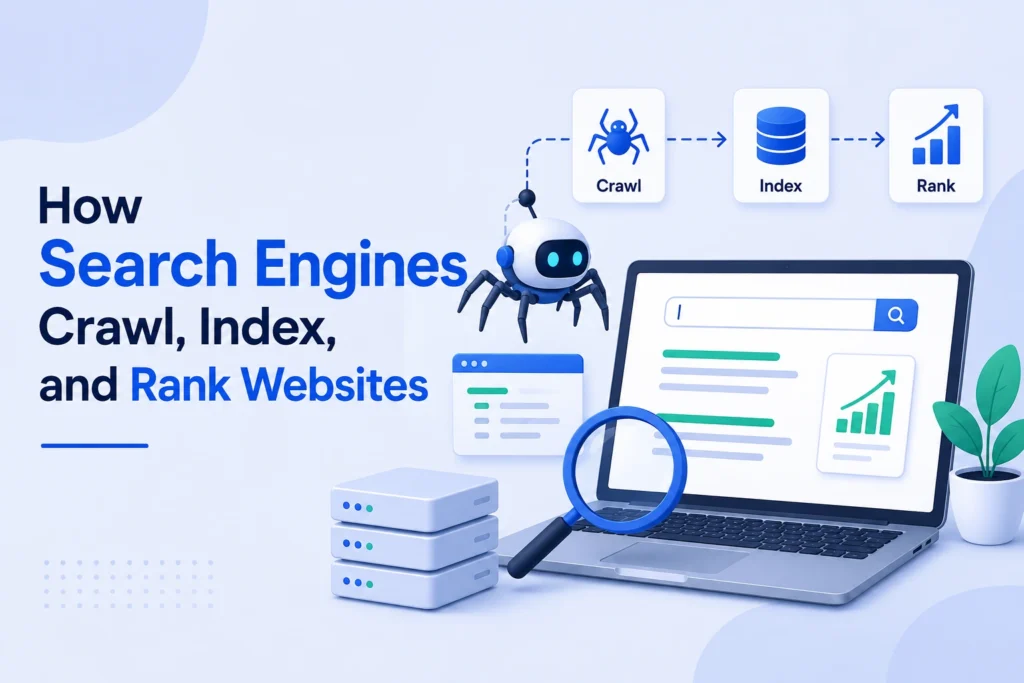
The answer lies in three essential processes: crawling, indexing, and ranking. Understanding these concepts is one of the first steps toward building a successful SEO strategy. Whether you’re a business owner, marketer, or someone learning SEO, knowing how search engines work helps you create websites that are easier for Google to discover and recommend.
At Basar Mir, we help businesses improve their online visibility by implementing modern SEO strategies that align with how search engines evaluate websites.
What Are Search Engines?
Search engines like Google and Bing are designed to help users find the most relevant information on the internet. They continuously scan billions of web pages, organize the information they collect, and rank pages based on their relevance and quality.
This process happens in three stages:
- Crawling
- Indexing
- Ranking
Let’s understand each stage in detail.
Step 1: Crawling – How Search Engines Discover Your Website
Crawling is the process where search engine bots, often called “crawlers” or “spiders,” visit websites to discover new and updated pages.
These bots move from one page to another by following internal and external links. Every time you publish a new blog or update an existing page, crawlers revisit your website to check for changes.
Several factors help search engines crawl your website efficiently:
- Clear website navigation
- Internal linking between pages
- XML sitemap
- Fast-loading pages
- Mobile-friendly design
- Proper robots.txt configuration
If search engines cannot crawl a page, it cannot appear in search results.
Step 2: Indexing – Storing Your Website Information
After a page is crawled, Google analyzes its content and decides whether it should be stored in its search index.
Think of the index as a massive digital library containing billions of webpages.
During indexing, Google evaluates:
- Page content
- Images
- Headings
- Meta information
- Internal links
- Structured data
- Overall page quality
If your page provides valuable and unique information, it has a higher chance of being added to Google’s index.
However, pages with duplicate, thin, or low-quality content may not be indexed.
Step 3: Ranking – Choosing the Best Results
Ranking is the final stage where Google determines the order in which webpages appear for a specific search query.
Google uses hundreds of ranking signals to identify which page best satisfies a user’s intent.
Some important ranking factors include:
- Content relevance
- Search intent
- Website authority
- User experience
- Mobile usability
- Page speed
- Content freshness
- Backlink quality
- Security (HTTPS)
Rather than rewarding websites that simply repeat keywords, Google prioritizes pages that provide accurate, trustworthy, and helpful information.
Why Crawling, Indexing, and Ranking Matter
Many websites struggle to generate organic traffic because they focus only on publishing content without understanding how search engines process it.
For example:
- If your page isn’t crawled, Google won’t discover it.
- If your page isn’t indexed, it won’t appear in search results.
- If your page isn’t well optimized, it may rank below competitors.
Understanding these three stages helps businesses identify where improvements are needed and create a stronger SEO strategy.
Common Issues That Affect Search Performance
Several technical and content-related problems can prevent your website from performing well.
Some common issues include:
- Broken internal links
- Slow website speed
- Duplicate content
- Poor mobile experience
- Missing XML sitemap
- Crawl errors
- Thin content
- Incorrect robots.txt settings
- Outdated information
Regular website maintenance helps resolve these issues before they affect rankings.
How to Help Search Engines Understand Your Website
Improving your website doesn’t require complicated techniques. Instead, focus on creating a website that is easy to navigate and provides value to users.
Here are some practical recommendations:
- Publish original and informative content regularly.
- Keep your website structure simple and organized.
- Update outdated pages with fresh information.
- Improve loading speed and mobile usability.
- Use descriptive page titles and headings.
- Add internal links to related content.
- Submit an XML sitemap through Google Search Console.
- Monitor indexing and crawl reports regularly.
Following these best practices makes it easier for search engines to discover, understand, and rank your website.
Why SEO Is More Than Just Keywords
Many beginners assume SEO is simply about adding keywords to webpages. While keywords remain important, modern SEO focuses on delivering the best possible experience for users.
A well-optimized website combines high-quality content, technical excellence, and user-friendly design. Businesses that understand how search engines evaluate websites are more likely to achieve long-term visibility and sustainable organic growth.
If you’re following a beginners guide to seo, learning how crawling, indexing, and ranking work is one of the most valuable foundations you can build before exploring more advanced optimization techniques.
Partner with SEO Professionals
SEO continues to evolve as search engines become smarter and user expectations change. Keeping up with algorithm updates, technical improvements, and content best practices requires ongoing effort and expertise.
Businesses looking for a trusted Digital marketing service in delhi can benefit from working with experienced professionals who understand how search engines evaluate websites and develop strategies that improve long-term performance.
At Basar Mir, we combine technical expertise, data-driven insights, and user-focused optimization to help businesses improve search visibility, attract qualified traffic, and achieve sustainable online growth.
Conclusion
Crawling, indexing, and ranking are the three pillars of every successful search engine. Understanding how these processes work helps you build a website that search engines can easily discover, evaluate, and recommend.
Instead of focusing solely on rankings, businesses should prioritize creating valuable content, maintaining a technically healthy website, and delivering an excellent user experience. Over time, these efforts contribute to stronger search performance and lasting online success.
FAQs
1. What is website crawling?
Website crawling is the process where search engine bots discover webpages by following links and scanning website content.
2. What does indexing mean in SEO?
Indexing is the process of storing and organizing webpages in a search engine’s database so they can appear in search results.
3. How do search engines rank websites?
Search engines rank websites by evaluating factors such as content relevance, website authority, page speed, user experience, backlinks, and search intent.
4. Why isn’t my website appearing on Google?
Your website may not be crawled, indexed, or optimized properly. Technical issues, poor-quality content, or crawl restrictions can also affect visibility.
5. How can I improve my website’s ranking?
Create high-quality content, improve website speed, fix technical issues, build quality backlinks, and regularly update your website with valuable information.
6. How long does Google take to index a website?
It can take anywhere from a few hours to several weeks, depending on your website’s authority, crawl frequency, and technical health.
7. Does publishing new content improve rankings?
Regularly publishing useful and original content helps search engines discover fresh pages and can improve long-term search visibility.
8. How can Basar Mir help improve SEO?
Basar Mir provides data-driven SEO strategies that help businesses improve crawlability, indexing, website performance, and search rankings through comprehensive optimization.