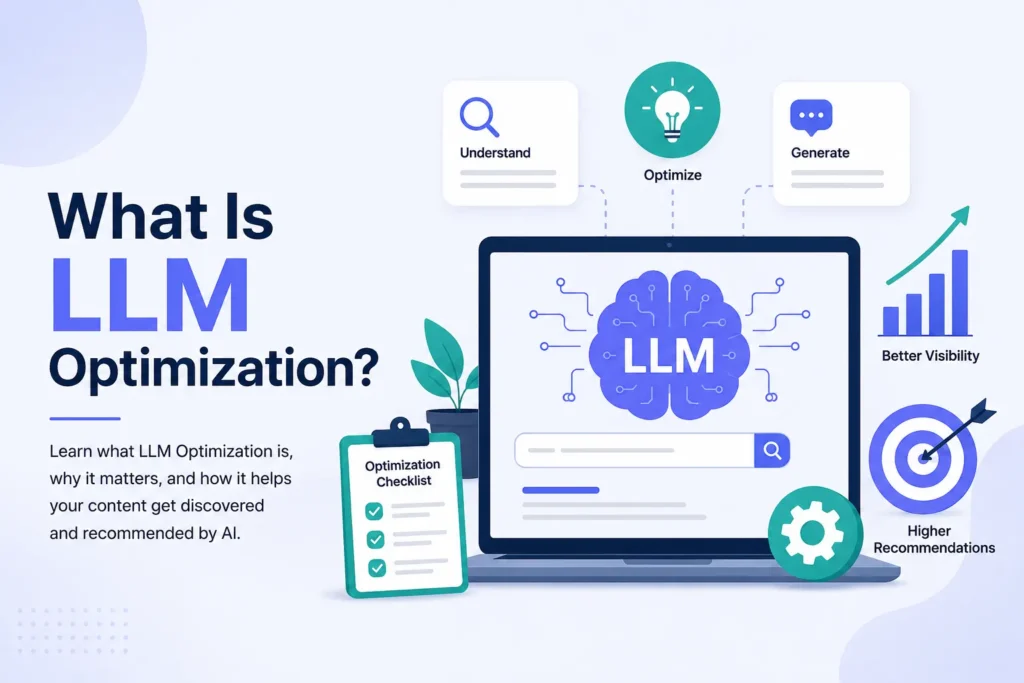
Traditional search engines are no longer the only way people find information online. Today, users increasingly rely on AI-powered tools such as ChatGPT, Gemini, Claude, and Perplexity to get direct answers to their questions. These large language model (LLM) platforms analyze vast amounts of information and generate conversational responses instead of simply displaying a list of links.
As AI-powered search becomes more popular, businesses, marketers, and content creators are looking for ways to ensure their content is visible within these AI-generated answers. This is where Large Language Model Optimization (LLMO) comes into play.
LLMO is an emerging strategy that focuses on making content easier for large language models to understand, trust, and reference when generating responses. Understanding the basics of LLMO can help businesses stay visible in the future of search and information discovery.
What Is LLM Optimization (LLMO)?
Large Language Model Optimization (LLMO) is the practice of optimizing digital content so that AI systems and large language models can easily understand, process, and reference it when answering user queries.
Unlike traditional search engine optimization (SEO), which aims to improve rankings on search engine results pages, LLMO focuses on increasing the likelihood that AI-powered platforms will use your content as a trusted source when generating responses.
The goal is not simply to rank higher in search results but to become a reliable source of information that AI systems can confidently reference.
Understanding Large Language Models
Before exploring LLMO further, it helps to understand what large language models are.
Large language models are advanced AI systems trained on massive amounts of text data. They use this information to understand language patterns, answer questions, summarize content, and generate human-like responses.
Popular examples include:
- ChatGPT
- Gemini
- Claude
- Perplexity AI
- Microsoft Copilot
These platforms process information differently from traditional search engines. Instead of displaying webpages in ranked order, they generate direct answers based on the information they have access to and consider trustworthy.
Why LLMO Matters
As AI-powered search tools gain popularity, content visibility is no longer limited to search engine rankings.
LLMO matters because:
- More users are turning to AI assistants for answers.
- AI-generated responses often summarize information from multiple sources.
- Businesses want their content included in AI-generated recommendations.
- Content that is easier for AI systems to understand may have greater visibility.
- AI search experiences are becoming part of everyday online behavior.
Organizations that adapt early to this shift can improve their chances of maintaining visibility as search technology evolves.
LLMO vs SEO: What Is the Difference?
Although LLMO and SEO share some similarities, they are not identical.
Traditional SEO
SEO focuses on improving visibility in search engine results pages by optimizing factors such as:
- Keywords
- Backlinks
- Technical website performance
- Meta tags
- User experience
The primary goal is to achieve higher rankings on search engines like Google and Bing.
LLM Optimization
LLMO focuses on helping AI systems understand and trust content.
Its priorities often include:
- Content clarity
- Context and relevance
- Structured information
- Authority and credibility
- Accurate answers to user questions
Rather than ranking webpages, LLMO aims to increase the likelihood of being referenced in AI-generated responses.
How They Work Together
LLMO does not replace SEO. Instead, it builds upon many SEO best practices.
Well-optimized content often performs better in both traditional search engines and AI-powered search environments. Businesses should view LLMO as a complementary strategy rather than a replacement for SEO.
How Does LLM Optimization Work?
Large language models process content differently than traditional search engines.
To improve AI visibility, content creators should focus on several key areas.
Creating Clear and Well-Structured Content
AI systems perform better when content follows a logical structure.
Best practices include:
- Using descriptive headings
- Organizing information into sections
- Keeping paragraphs concise
- Providing clear explanations
A structured format helps AI systems understand relationships between topics and extract relevant information more effectively.
Answering Questions Directly
Many AI-powered searches are conversational.
Users often ask questions such as:
- What is LLMO?
- How does LLM optimization work?
- Why is AI search important?
Content that provides direct, concise answers to these questions is more likely to be useful for AI-generated responses.
Demonstrating Expertise and Credibility
Trust plays a major role in AI-generated information.
Content should demonstrate:
- Subject matter expertise
- Accurate information
- Reliable sources
- Industry knowledge
- Updated insights
The more trustworthy the content appears, the greater its potential value to AI systems.
Building Topical Authority
Topical authority refers to covering a subject comprehensively.
Rather than publishing isolated articles, businesses can create content clusters that address multiple aspects of a topic.
For example, a website discussing LLMO might also publish content about:
- AI search optimization
- Generative engine optimization (GEO)
- AI-friendly content creation
- Conversational search
- AI content discovery
Comprehensive coverage helps establish authority within a topic area.
Best Practices for LLM Optimization
Focus on User Intent
Understand what users want to know and provide clear answers.
Content should solve problems, answer questions, and address common concerns.
Use Natural Language
AI systems are designed to understand conversational language.
Write naturally while maintaining professionalism and clarity.
Avoid keyword stuffing or unnatural phrasing.
Organize Content Logically
A clear hierarchy helps both readers and AI systems understand information.
Use:
- One H1 heading
- Relevant H2 sections
- Supporting H3 subsections
- Bullet points and lists where appropriate
Keep Information Accurate and Updated
AI systems value reliable information.
Regularly review content to ensure:
- Facts remain accurate
- Statistics are current
- Examples are relevant
- Industry developments are reflected
Include Helpful FAQs
Frequently Asked Questions align with how users interact with AI assistants.
FAQ sections provide concise answers that can improve content accessibility and user experience.
Common Challenges of LLMO
While LLMO offers exciting opportunities, it also presents challenges.
These include:
- Rapidly changing AI technologies
- Limited visibility into AI ranking mechanisms
- Evolving best practices
- Difficulty measuring AI citations and mentions
- Increased competition for AI-generated visibility
Because the field is still developing, businesses should remain flexible and continuously monitor changes in AI search behavior.
The Future of LLM Optimization
AI-powered search is expected to continue growing over the coming years.
As users increasingly seek direct answers instead of traditional search results, content creators will need to adapt their strategies accordingly.
Future success may depend on:
- Creating trustworthy content
- Demonstrating expertise
- Answering questions clearly
- Structuring information effectively
- Maintaining content quality over time
Businesses that embrace these principles today will be better prepared for the next generation of search experiences.
Conclusion
Large Language Model Optimization (LLMO) is an emerging approach that helps content become more visible and useful within AI-powered search platforms. While traditional SEO focuses on search engine rankings, LLMO aims to make content understandable, trustworthy, and reference-worthy for large language models.
As AI assistants become a common way for people to discover information, optimizing content for both search engines and AI systems will become increasingly important. By focusing on clarity, authority, structure, and user intent, businesses can improve their chances of staying visible in the evolving digital landscape.
Frequently Asked Questions
- What does LLMO stand for?
LLMO stands for Large Language Model Optimization, a strategy focused on making content easier for AI systems to understand and reference.
- How is LLMO different from SEO?
SEO aims to improve rankings in search engine results, while LLMO focuses on increasing visibility within AI-generated responses and conversational search platforms.
- Why is LLMO important?
LLMO helps businesses adapt to the growing use of AI-powered search tools and improves the chances of content being referenced by large language models.
- Can LLMO replace SEO?
No. LLMO complements SEO rather than replacing it. Both strategies work together to improve content visibility across traditional and AI-powered search experiences.
- What types of content benefit from LLMO?
Blogs, guides, FAQs, knowledge-base articles, product pages, and educational content can all benefit from LLM optimization when structured clearly and written with user intent in mind.
- Is LLMO only relevant for large businesses?
No. Businesses of all sizes, content creators, and website owners can benefit from optimizing content for AI-powered search and language models.